Diamondback terrapins are a very special species of turtle. They are probably the only turtles which live exclusively in brackish water. There are found all along the east coast of the United States, especially along Georgia's coast. In addition to occupying a very specific niche, they are a very beautiful species of turtle. The color of their skin can range from powdery white to black, and all shade of blue in between. Frequently their skin is adorned with unique patterns which can be either speckled or linear. The shell on their backs, called a carapace is also often patterned. Terrapins from South Carolina are often distinguished by their red or amber belly shells.
The species is separated into a handful of subspecies. Members of the subspecies can interbreed, but their natural habitat ranges are so separated that this rarely happens in nature. The turtles are not federally protected, although they probably should be. In the state of Georgia, they are a protected species. Rhode Island denotes them as endangered, and Massachusetts considers them threatened. Perhaps Georgia, or the United States in general, should adopt more protective measures when it comes to the diamondback terrapins.
The species faced rapid decline during European colonization of the east coast. They were considered a delicacy and hunted all over their range for gourmet restaurants. Current threats to their populations are related to habitat destruction. I work with a student organization at Armstrong Atlantic State University called TERPS (Terrapin Educational Research Program of Savannah) which is concerned with their conservation. My good friend Andrew Neidlinger is currently running this organization and performing field research on the wild populations of terrapins near Savannah, Georgia.
While degradation of the marshes themselves is a major threat to the turtles, road construction is the most significant cause of their decline in Georgia. Highway 80 connects Savannah to Tybee Island. During the summer, this highway carries high volume traffic from Savannah to the beaches on Tybee. The speed limit on parts of the road is 55, but drivers often speed. Unfortunately, the peak season for tourism on Tybee coincides with the turtles nesting season. Females cross from the marsh on the northern side of the road to nest on the southern side. All too often, they are hit by cars.
The TERPS club has a hotline for drivers to report struck turtles. If we find a live turtle, we rehabilitate the animal in the lab before releasing him or her to a safer location. If we find a recent female victim of roadkill, we to see if she is gravid. Often we recover eggs which we can hatch in our lab. Last October, we hatched 3 baby terrapins in our lab. On June 13, 2013, Andrew and I took these 3 babies, as well as another wild born baby whom we recovered and nourished in the lab, to Fort Pulaski to release. Mary Landers, a reporter from Savannah Now, met us there to learn about our project and the threats to the turtles. Because the vast majority of baby turtles are eaten rapidly after they hatch, allowing them a 8 months of growth in the lab greatly increases their chance of survival in the wild.
Currently, there is talk of widening Highway 80 to accommodate more Tybee traffic. The TERPS organization has a suggestion, should this expansion occur. If the road is expanded, a tunnel should connect the marsh beneath it. This would give the terrapins a safe way to cross from one side of the marsh to the other to nest.
It is important for the public to know about these turtles and learn about conservation efforts. Their population has declined rapidly, and their nesting habits are being altered by human interference. If this species is to thrive, efforts must be made to protect them. Drivers should not speed on the stretch of Highway 80 that cuts through the marsh, or else they risk hitting pregnant females. If drivers do hit or see a hit turtle, they can contact the TERPS club to rehabilitate the animal or extract eggs. Also citizens should be aware that the species is protected, but current population estimates show such a rapid decline that they probably should be considered threatened or endangered. With this knowledge, the public can support legislature that demands more stringent protection for the turtles.
Here is the hotline number:
912.659.0978.
These are some photographs I took of the turtles at our facility at Armstrong. The first picture is of one of the babies that we released yesterday.
The next photo is of a juvenile female called Cleopatra. Her mother was a roadkill victim and we hatched Cleopatra in our lab. Her clutchmates were released back to the wild. Notice her striking pattern. The carapace is marked with concentric lines which can be used to estimate the turtles age. Each lighter band signifies a year of growth.
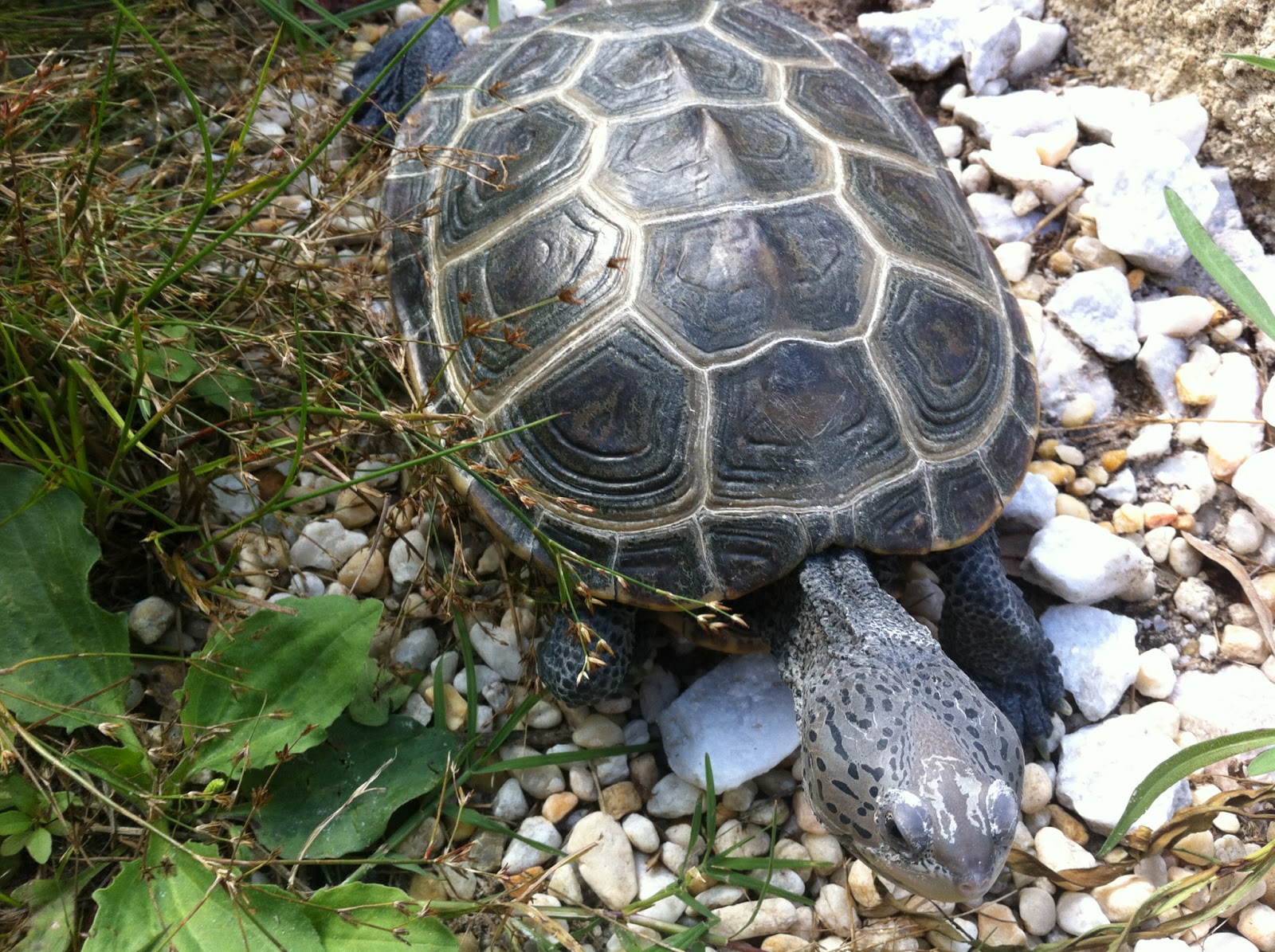
The last photo is of a female called Satilla. She was injured and thrives in captivity. However, her injury would put her at a disadvantage in the wild, so we chose to keep her in our captive breeding program. She is currently pregnant and we are hoping to hatch her eggs in the lab!! Notice that her pattern is more speckled and less linear than Cleopatra's.
Thanks for reading about the terrapins, and please support protection for this species by not speeding on Highway 80, calling in hurt animals, and supporting protective legislation!
Keep an eye out in the Savannah Morning News for Mary Landers's article about the turtles. You'll see some great photos of the turtles and hear Andrew's expert opinion on their conservation. You might even see a cameo by me in the article!
Friday, June 14, 2013
Wednesday, June 12, 2013
How to Make Fish the Easiest and Most Educational Pet You'll Ever Own
People never believe me when I say I've never cleaned my fish bowl. But I swear it's true!! And I've had it for almost a year. When I set up my fish bowl, I was taking a limnology class. Limnology is the study of inland bodies of water, such as lakes and rivers. The course inspired me to create my own mock ecosystem in a fish bowl. I like to think that it had a positive impact on my understanding of the course material, but at the very least, it has entertained the crap out of me and my boyfriend. I imagine that kids would probably like it a lot too. Setting up a fish bowl like mine is probably the best way to own a pet if you are either incredibly lazy or irresponsible.
First things first, your bowl must be in a sunny location. Ours is next to a west-facing window in our house. Typically west or south-facing windows will afford you the most light. Sunlight is crucial for the success of this project. Fill the bottom of the bowl with rocks or something more creative. It's important that the plants be able to grow roots into the substrate. Rocks leave a lot of nice little spaces for them to grow through. Sand might be too dense, but I haven't tried it.
Next, pick some plants. I have a bamboo plant, a cutting from a pothos houseplant, elodia, and a couple of aquatic plants that I bought at Petsmart. These plants will produce fresh clean oxygen for the animals in your bowl. The animals will not be able to survive without oxygen. If you look closely at the plants in my fish bowl, you'll see tiny bubble rising from the plants. This is the oxygen itself. When you see these oxygen bubbles, you'll know that the bowl is ready for animals.
Snails are the next step. Snails will clean the algae and debris from the bowl. Snails also self-regulate their population size. They will reproduce rapidly and disappear. This is because they eat each other when there are too many of them. My bowl has one fish in it. She's a molly of some type. Originally we had a guppy also, but the molly ate him. We didn't want to torture any more fish, so she's the only one. It's probably not a good idea to have more than two fish unless the bowl is very large with lots of plants.
If you have a sufficient amount of plants, you will literally have to do nothing to maintain your bowl. Once, I went out of town for a month and my friend who was house-sitting completely forgot about the fish bowl. The molly didn't get fed for an entire month, but she just nibbled on plants and algae. We do feed her occasionally (when we remember), but it's certainly not necessary. Honestly, I think she prefers the vegetation.
Anguilla: A sustainable approach to luxury travel
If you're planning an exotic getaway, you should seriously consider the small Caribbean island of Anguilla. Famed for its crystal clear water and white sand beaches, it's also renowned for its five-star cuisine and resorts. It's a quiet and remote island with a handful of kickass bars, but is a 20 minute ferry ride from cosmopolitan St. Marten. You may even share the island with a handful of celebrities. Scenes of the pristine beaches are featured in a recent Rick Ross music video for "Diced Pineapples." Check out the video just to see the beaches.
You'll be stunned by the marine life and beaches, but you may also be impressed by the local use of natural resources. I say "may" because Anguillians don't often brag about their use of green methods and technology. They don't broadcast it-- they just use the free resources that nature courteously provides in a quiet and respectful manner. For instance, almost every home in Anguilla collects rainwater and stores it in a cistern. This is the primary source of water for locals, and they use it year-round. Furthermore, many homes use solar panels connected to their water tanks for heating bath water.
If you're interested in marine life, luxury, or sustainability, you'll doubtlessly be enchanted by the colorful culture of Anguilla.
Jah bless!
Monday, June 10, 2013
American Roti
If you've ever aspired to make bread but been intimidated by the complex ingredients and directions, I've got a solution worth trying. I call it American Roti. Roti is a flat bread popular in southeast Asia, especially India. It's also a staple in Trinidad. Different flours are used regionally, but it's a versatile recipe. Feel free to experiment with different flours. I make mine with whole wheat flour which gives it a pleasantly coarse texture. I've also had a version made with corn meal that was very tasty. I might have to try that next. Eat it right out of the pan for a snack, soak up sauce from stews and gravy with dinner, or wrap up leftovers in it for lunch. Here's my recipe:
Mix these ingredients in a bowl.
- 3 cups whole wheat flour
- 1 tablespoon baking powder
- 1 tablespoon coarse salt
Mix these ingredients in a bowl.
- 2 sticks of butter
Dice the butter in little pieces and mix with the flour mixture.
- 1/2 cup cool water
Drip the water in gradually and knead the mixture until the butter is incorporated. Wrap it up and let it chill in the fridge for at least one hour.
Break off pieces (you can get 15-20 from this recipe), and roll them out on a floured surface. If you don't have a rolling pin, you can use a wine bottle and it will work just as well. If the dough sticks to the pin, flip it and roll the surface that's been in contact with the floured surface. I like to roll mine to a tortilla thickness.
Fry in a pan and enjoy.
Garden Ecology 101
I got interested in gardening because I wanted to grow food- not flowers. Flower gardening some how didn't seem utilitarian enough to me until I learned a little more about garden ecology. I quickly learned that growing food is significantly more complicated than putting a plant in dirt and giving it some water.
Soil is a complex heterogeneous mixture. This means that it consists of many separate and distinct parts. It's home to animals, bacteria, and fungi that decompose waste like manure and plant parts. These little guys are the magicians responsible for turning your kitchen scraps into nutrient-rich soil in your compost heap.
The diversity of life forms in your garden starts in the soil, but also includes both your plants and the animals that interact with them. Most of the animals that you see in your garden are probably insects; some of them are helpful, but some of them hurt your crops. When I tried to grow strictly veggies, I definitely had more harmful than helpful insects. A friend suggested that I include some flowers in my garden, and I was converted. I now recognize and appreciate the wonders of growing flowers. They attract the good pollinators like honeybees and the predators that eat the nuisances like aphids. Plus they look gorgeous and smell delicious. Best of all, I can still use them for food. Here are some clever ways to consume flowers:
Roses- delicious in sweet foods like ice cream, can be baked in cakes
Chamomile-smells charming and perfect for a cup of tea before bed
Lavender-also great in tea
Marigolds-flavorful addition to salads
Sunflowers-sunflower seeds, duh!
For me, the bottom line is that gardening is more about growing an ecosystem than one vegetable and flowers are instrumental in this process. They also make your outdoor space more vibrant and interesting. And you can cut them to bring inside and make your home lovely and fresh. Don't forget to stop and smell the roses, or whatever you grow.
Sunday, June 9, 2013
Why Georgia Is Awesome, Part 1
Georgia is a seriously underrated state. The west coast is obviously the popular spot for post undergrads to flock to, what with California and Washington's progressive cannabis legislation and trendy TV shows like Portlandia. Trends aside, Georgia actually shares many compelling natural attractions with west coast states. For instance, it too is a state famous for both its beaches and its mountains. Georgia is charmingly unique and disarmingly diverse in terms of its natural environments.
Georgia's coast is home to the world's most productive ecosystem in terms of oxygen production. That's right-- Georgia's coastal marshes produce more oxygen per square foot than rain forests. Salt marshes are environments which are distinguished by the presence of Spartina alterniflora, commonly called smooth cordgrass. Smooth cordgrass environments sequester pollution chemicals and produces oxygen more efficiently than any other habitat on Earth.
Georgia's coast is protected by a layer of barrier islands which separate the mainland from the Atlantic Ocean. This is a major reason as to why Georgia has sandy beaches, unlike the west coast's rocky beaches. The barrier islands also protect coastal cities like Savannah from hurricanes. Unlike cities in Florida, Savannah is practically never damaged by hurricanes. Furthermore, the water along Georgia's coast is warmed by the Gulf Stream ocean current. The Gulf Stream carries warm water from the Caribbean, near the Equator, all the way up the east coast. The sandy beaches, safety from hurricanes, and warm water make Georgia's beaches prime for swimming.
Admittedly, every state in the USA is charmingly unique. Georgia, however, is one of the most underrated states and is home to awesome swimming beaches.
Introduction to Callinectes
Hey there! I'm Cammie Allen, from Atlanta, Georgia. I live in Savannah, Georgia, where I study marine biology and environmental studies. I am a victim of wanderlust and have a passion for sustainable food resources, marine ecology, and delicious food. The purpose of Callinectes is to share ideas about traveling, eating, and living well with respect for the natural world. The name Callinectes is a Latin word which means "beautiful swimmer." It is also the genus of a group of crabs which includes the famously delicious blue crab. Dive in and enjoy!
Subscribe to:
Posts (Atom)


